Blog

  • Sad Stories

    For solo ukulele, ca. 11′

    Classical Pieces for the Intermediate Player
    In Standard Notation and Tab

    No. 1: Rocking
    No. 2: Still
    No. 3: Agitated
    No. 4: Restless
    No. 5: Weeping
    No. 6: Fired Up
    No. 7: Moving

    Score SamplePrinted Score (U.S. only) – $17.00
     Digital Edition PDF – $12.00

    About the Music

    The Sad Stories for ukulele are intermediate level pieces.  They are the latest of my collections of short works for the developing classical ukulele player. In music, the minor modes (aeolian, dorian, melodic minor,  etc.) are often used to depict a sad mood. In this collection, these darker tones are explored in each of 7 minor  modes: C, D, E, F, G, A, and B. Therefore, they offer the player a chance to practice several different key signatures, and thus different fingerings and chord positions.  Each Story is expressive and intimate, evoking  melancholy and, at times, brighter moments too. 

    -LKN

  • String Quartet OCD Podcast, Residency, Press

    Colorado Public Radio released a podcast about String Quartet OCD on Centennial Sounds in August 2017.

    In September 2017, The Playground Ensemble and I did a residency with String Quartet OCD at Children’s Hospital Colorado under the auspices of Chamber Music America’s Residency Parternship Program. We were grateful to be able to reach audiences including providers, patients, and the public with lectures, Q&A sessions, and performances. Here is some press we received:

    CBS 4 Denver: Mother, Composer Suffered Postpartum OCD

    5280 Magazine Online: A Local Composer Uses Music to Explain Her Struggles with Postpartum OCD

    In October 2017, I presented the piece with performers from the Colorado Symphony at the Women’s Music Symposium, put on by the Denver Young Artists Orchestra at DU’s Lamont School of Music. In conjunction with this event, Kumasi Aaron of Scripps Media made this story, which was broadcast on news stations nationally:

    More Than Music: How Composing Song Helped Mother Overcome OCD


  • The Musical Life with James Cline

    Guitarist and ukulele-player extraordinaire James Cline and I talk composition process, books, and even chess on the inaugural episode of his new podcast, The Musical Life with James Cline. After a few more episodes get posted, you’ll be able to subscribe on iTunes. Check it out!

  • TEDxMileHighWomen 2016

    I was honored to be chosen to present a talk, along with The Playground Ensemble performing the last two movements of String Quartet OCD, at TEDxMileHighWomen in October 2016. While the prospect of speaking in front of 2800 people was daunting, TEDxMileHigh does a great job of preparing speakers, with two months of speaker training and intensive feedback. The event was a peak experience for me, and the positive response from audience members has been overwhelming.

  • String Quartet OCD News

    I’m happy to say that my String Quartet OCD has received some press over the last several months. This piece, in the autobiographical tradition of string quartets (think: Beethoven, Smetena, Janacek, Berg, Shostakovich…), concerns my experience with postpartum OCD, a serious condition that affects up to 9% of postpartum mothers and some fathers, too.

    Here are the links to press and reviews:

    Colorado Public Radio: “Denver Composer Reflects on Postpartum OCD in New Piece”

    The Denver Post: “Colorado Composer Turns Experience with Postpartum OCD into Powerful Quartet”

    5280 Magazine: “A Sneak Peek into TEDxMileHighWomen”

    Mile High Mamas: “The Gift of Postpartum OCD”

    The Mighty: “The Thoughts I Had After Having a Baby Didn’t Make Me a Monster.”

    Deforming Prisms: “Intimate Conversations: Thoughts on Loretta Notareschi’s String Quartet OCD and Stephen Bailey’s Love Story”

    La Musica di Donne: “String Quartet OCD”

    AllMusic: “Playground Ensemble String Quartet/Loretta K. Notareschi: String Quartet OCD”

    CD Hotlist: “Loretta Notareschi: String Quartet OCD

    Midwest Record: “Disegni: Loretta Notareschi/String Quartet OCD

    Infodad: “Quartets and More”

  • Colorado Public Radio story

    Colorado Public Radio featured a story in February 2016 about my new piece String Quartet OCD: Denver Composer Reflects on Postpartum OCD in New Piece

    Sarah Whitnah, Leslie Sawyer, Donald Schumacher, and Richard vonFoerster of The Playground Ensemble recorded the piece in the CPR studio. Here is the third movement, “Shame:”

    The EP release will be available on May 6, 2016 from CD Baby, Amazon, and Itunes.

    Read more about the piece and see score samples here.

    String Quartet OCD was commissioned by The Playground Ensemble and premiered in Denver in February 2016.

  • Are you still on sabbatical?

    Just about anytime I see a friend these days, they ask, “Are you still on sabbatical?” The answer is yes! I am on sabbatical from the Music Program at Regis University until August 2015. “What have you been doing?” is the next question. At which point I proceed to give a long rambling answer, which I’d like to put here, hopefully in a less rambling fashion.

    One, I’ve been improving my skills on Max/MSP, a program in which I’ve been developing a software-based instrument called the Drone Machine. The Drone Machine is now in its third…er…fourth, maybe? iteration, and I am currently writing for it and the Laramie County Community College New Music Ensemble. (They selected me and D. Edward Davis for the honor of writing a new piece for the group earlier this year.) Thanks to Bryan Christian, LCCC NME Director and composer, for making it all possible! This piece will premiere on May 5 in Cheyenne.

    Second, I’ve been planning and sketching a few new pieces for the Playground Ensemble, including a new piece for this summer’s Biennial of the Americas in Denver, and a new string quartet to premiere in the 2015-16 season. I’m very excited about these projects, which are still in the early stages.

    Third, I’ve been editing, polishing, adding to, and in some cases subtracting from my catalog, which I recently have begun to offer for sale via my new publishing company, Disegni Music. I even had signs made!
    2015-01-09 14.33.082015-01-09 14.34.15

    This work is…not exactly boring…more like housework…let’s just say…highly detail-oriented and time-consuming! It’s also necessary, and I’ve been needing to do it for years. This is what it looks like:
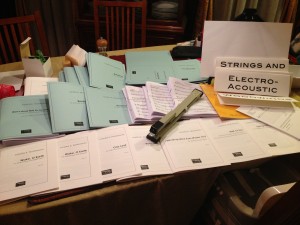
    2015-01-07 22.08.19

    The best part of the process so far has been attending the Chamber Music America conference in January, where I met many talented and friendly performers, presenters, and composers. I even raffled off a box of Rocky Mountain Chocolate Factory truffles to the lucky winner, Matthew Levy, of the inestimable PRISM Saxophone Quartet. You may be interested to know that my 2-year old daughter R supervised the setup at the conference:
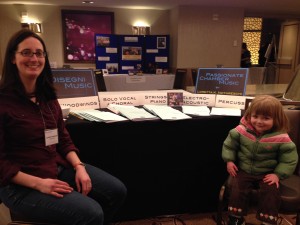
    2015-01-15 20.18.17

    Fourth, I’ve been updating my website. Also a highly detail-oriented and time-consuming process, again totally necessary! Thanks for visiting it!

    Fifth, well, is everything else. Work for the Walden School’s Creative Musicians Retreat (you should come!), work for the board of the Playground Ensemble, working on my piano improvisation skills, singing with the First Universalist Singers, traveling to see extended family in Oklahoma and Maryland, spending time with my wonderful husband Kevin, and taking care of my darling R.

    Now, tell me, what have YOU been up to? Really, I’d love to know. Please drop me a line anytime at loretta at disegnimusic dot com.

  • Composing with Drones

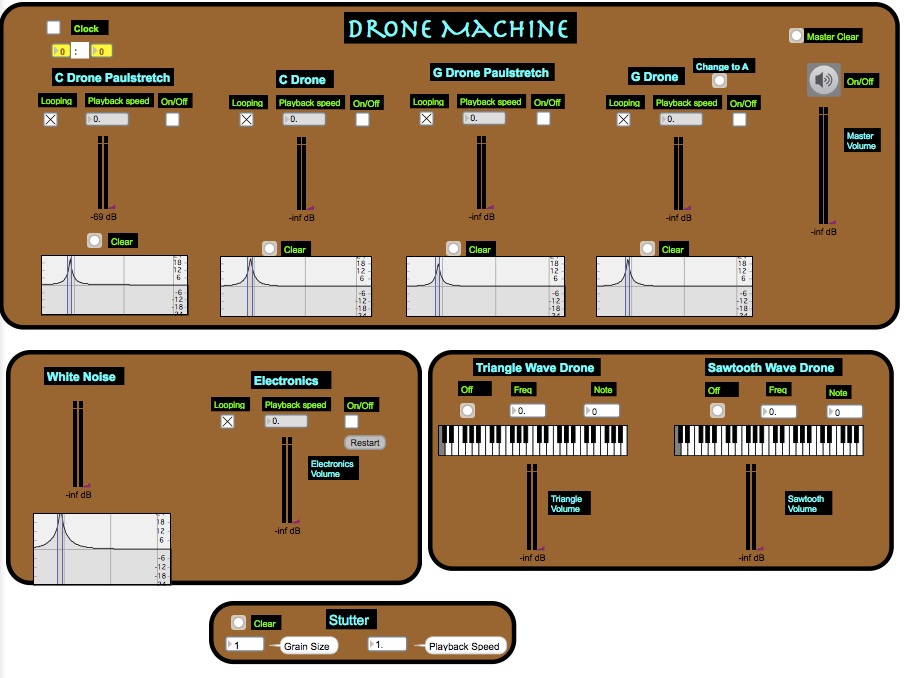
    Recently I’ve posted on this website a series of pieces using an electronic instrument I designed in Max. It’s called the Drone Machine, and here’s a screen shot of the playing surface:

    Drone_Machine_Image

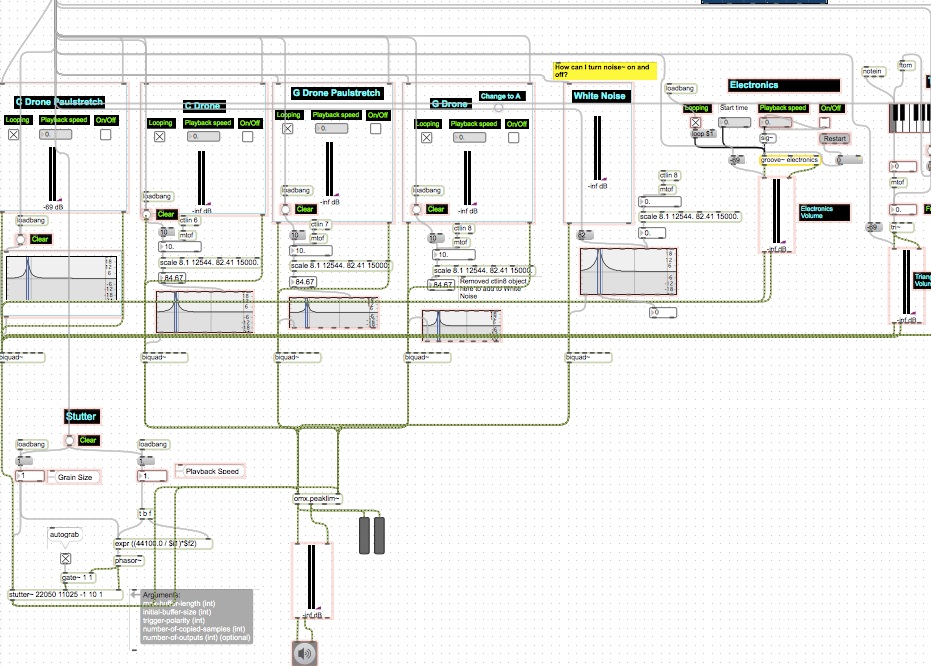
    This surface hides the construction of the instrument, which under the hood looks in part like this:

    Under_the_hood_Drone_machine

    Basically, with the Drone Machine you can play pre-recorded drone sounds, white noise, some other electronic samples, and some old-school synth sounds. The graphs you see allow you to filter the harmonic spectra of the sounds interactively, and the controls on the bottom allow you to apply some granular synthesis. A MIDI controller makes it easier to use the instrument but is not required.

    What does this sound like, you ask? Well, it depends on the piece! The first piece in the series is Bordone (2012), for violin and laptop. The laptopist uses the Drone Machine. Here’s Mark Davenport playing the Drone Machine, with me on the violin:

    Next came Bordoncello (2014), for cello and laptop. Again, the laptopist uses the Drone Machine, and also plays a telephone pick-up over the laptop to generate some pretty wild electronic sounds. Here’s Richard vonFoerster on cello and me on the Drone Machine/telephone pick-up:
    [youtube https://www.youtube.com/watch?v=g8wIbt9fFhs]

    Then, there’s How’s All to One Thing Wrought (2014), which is for Drone Machine alone, and uses only one sample, the low C on the cello, manipulated in various ways. Here’s me on the Drone Machine:

    Finally, I wrote Bordonquartet (2014), for string quartet and Drone Machine, plus telephone pick-up sounds again. This is the Spektral Quartet and me:

    The word “bordone” means “drone” in Italian. I chose Italian for the title because the Max workshop I took in Italy in 2012 got me started down the path toward these pieces. While each one uses drones, the pieces differ in many important respects. And because they are largely improvised, they are also different each time they are played. I find this combination of improvisation and droning musically powerful, and I hope you enjoy the fruits of my exploration of these ideas.

    Recently I was asked if the Drone Machine was available for other people to use. You can order the Max patch (“patch” is what Max calls its files) from this page — just choose one of the Bordone series of pieces to purchase and I will send you the patch, the sound files that go with it (though you can use your own if you prefer), the text-based score for the piece, and some instructions.

  • A Summer of Composition

    It’s been a great summer of composition projects!

    First, I arranged Carol Thomas Downing’s haunting tune Walden (originally written for the Walden School) for SAB Chorus, Violin, and Piano, and the First Universalist Singers premiered it in June with John Hubert directing, Sarah Libert on piano, and me on violin. This was the third (summer) of my four pieces for this group on the four seasons.

    Second, I finished my new piece Balance and Swing for the Boulder Symphony. They’ll premiere it on September 21. Since the piece is based on the American folk tradition of contra dance, caller Ed Hall and friends will present a pre-concert lecture and dance lesson (!) before the performance at the First Presbyterian Church in Denver. (Dance lesson at 6, concert at 7.)

    Third, I finished One Leaf, the autumn piece for the First Universalist Singers. I was excited to collaborate on this with my husband, Kevin Garlow, who wrote a beautiful poem from the point of view of an autumn leaf. This piece will be premiered on November 17th at the First Universalist Church of Denver.

    Really looking forward to these premieres and also my projects for fall and winter. Stay tuned…

  • Going to Illinois

    I’m excited to be traveling to Bolingbrook, IL May 12-15 to hear the midwestern premiere of Spring Quiet by the Bolingbrook High School singers, under the direction of Lawrence Fisher. This follows the March world premiere of the piece in Denver by the First Universalist Singers, directed by John Hubert.

    Spring Quiet is the second of four pieces I’m writing for the First Universalist Singers–one on each season. The winter piece is Wake, O Earth  (SATB/English Horn version). The summer and fall pieces are forthcoming. This has been an immensely gratifying project, as I love writing for musicians whom I know. Also, it’s been great to sing in the premieres. Particularly helpful in making revisions, since I’m part of the rehearsal process.