Community and Congregational Songs
Concert Music and Church Anthems
Community and Congregational Songs
Let Us Sing! Community Songs for Gathering and Going Forth (2019)
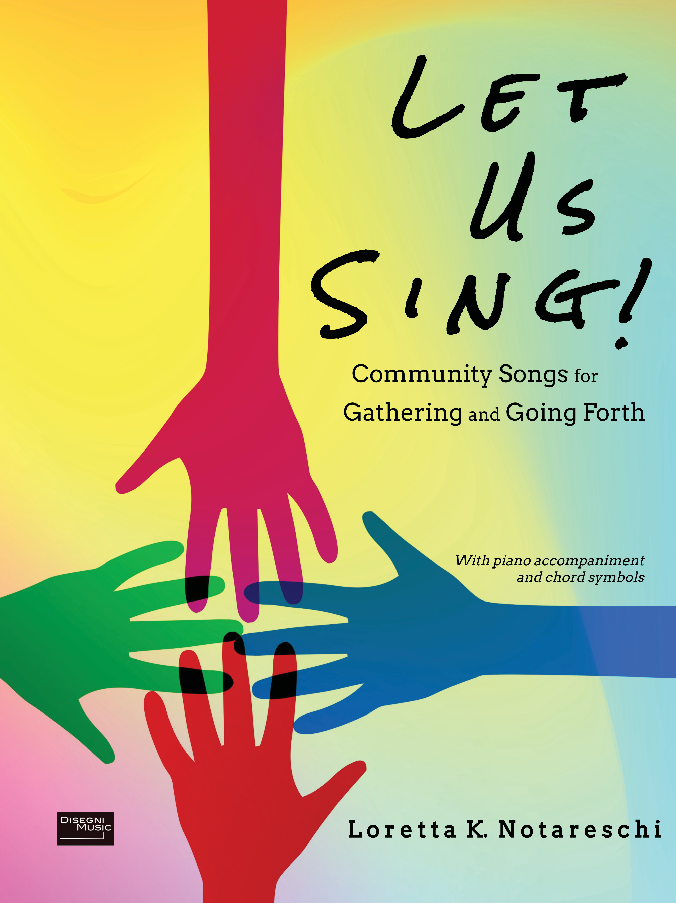
For unison voices and piano, with optional harmony parts. Eight songs intended for community building. Four gathering songs bring people together in celebration, in mourning, in blessing, and in meditation. Four songs for going forth encourage people to go out in love, in commitment, in peace, and in joy. Order here.
Rounds of Faith (2015)

For 3 or 4 voices. Covering a wide variety of spiritual themes, these rounds are suitable for use during a church service, retreat, conference, camp, school meeting, or other community setting. Order here.
Hail, O Sun (2009)
For four voices and harp/piano (optional)
A simple round suitable for Advent, Christmas, or Winter Solstice. Order here.
The Reason We’re Singing (2016)
For Unison or 2-Part Mixed Chorus and Keyboard, 2′
by Michael Frank, with 2-part arrangement by Loretta K. Notareschi.
A song to give us a feeling of reverence for the mysterious and support from those joining us in life’s unpredictable journey. Order here.
Grateful, We Raise Our Voice (2017)
For Unison Choir or Congregation, 1′
A song of thanks. Order here.
Three Thanksgiving Songs (2019)
For choirs or congregations
Two rounds and a two-part mixed song. Order here.
Concert Music and Church Anthems
Climate Mass (2024)
For Mezzo-Soprano, Tenor, and Baritone Soloists; SSATB Choir; and Chamber Orchestra or Piano
Words from the Ordo Missae (Latin Mass) and by Alyse Knorr
A work to inspire action for people and the Earth
Unfallen World (2023)
For SATB, Piano, and Optional Cello
Words by Alyse Knorr
An anthem inspired by C.S. Lewis’s Space Trilogy. Order here.
Sleep Now, Child (2020)
For SATB or SSAA Divisi and Piano
Words and music by Loretta K. Notareschi
A comforting lullaby. Order here.
Love’s Divine Refrain (2019)
For SAB Chorus and Piano
Words and music by Loretta K. Notareschi
A heartfelt anthem about loving kindness. Order here.
So Live! (2017)
For SATB or SSAA Chorus, 3’15”
Words and music by Loretta K. Notareschi
A song for finding joy in the midst of grief. In memory of Emily Roebken (1985-2017). Order here.
Three Wind Songs (2017)
for SSA Choir, 4′
On poetry by Gerard Manley Hopkins, SJ
Three short songs on the theme of the wind. Learn more here.
The Reason We’re Singing (2016)
For Unison or 2-Part Mixed Chorus and Keyboard, 2′
by Michael Frank, with 2-part arrangement by Loretta K. Notareschi.
A song to give us a feeling of reverence for the mysterious and support from those joining us in life’s unpredictable journey. Order here.
An die Musik (2013)
For SATB Choir and Orchestra or Piano, 3′
A short song in praise of music, arranged from Schubert. Order here.
One Leaf (2013)
For SATB Choir and Piano, 3’30”
A song about the cycle of life, on “One Leaf (Autumn)” by Kevin Garlow. Order here.
Walden (2013)
For Solo Voice, SAB Choir, Violin, and Piano or Unison Choir, Violin, and Piano, 4′
A song about finding peaceful time alone. Arrangement of original tune by Carol Thomas Downing.Order here.
Spring Quiet (2012)
For SSAATTBB or Unison Choir and Piano, 3.5′
A song about the pleasures of spring. Order here.
Sumer is icumen in (2012)
For SSAATBB Choir, SATB Recorders, Bassoon, and Handbells, 5′
An arrangement of the medieval round about summer’s arrival. Order here.
Wake, O Earth (2011)
For SATB or TTBB Choir and English Horn or Trumpet, 3′
A song suitable for Advent, Christmas, or Winter Solstice. Order here.
Italia mia (2007)
For SATB choir, 9’
A song about the quest for peace. Order here.
Pace, Pace, Pace (2007/2014)
For SATB choir, 5′
The last two movements from Italia mia, this piece exhorts the powerful to seek peace. Order here.